On 1 September 2026, the first Good Future AI conversation took place at GoodVibes Foundation in Vienna. It was intentionally not a corporate AI conference. The question was more basic: when AI changes faster than institutions can explain it, what kind of community helps people stay capable, creative and useful to one another?
We talked about where we actually are with AI now, what is moving quickly, what remains uncertain, and why the useful response is neither panic nor hype. The working idea that came out of the room is Good Future: a nonprofit, AI-native community where people can share what they are learning and building, turn raw information into useful public knowledge, and grow through contribution.
The website will be the common archive. Members will be able to send links, papers, code, files, projects and observations into a Good Future agent. The agent will help structure a post; a human moderator will review it; approved contributions will be published here and adapted for the Good Future channels on LinkedIn, Bluesky, X and Telegram. Over time, a transparent karma protocol will measure the verified attention and usefulness that contributions create.
We are deliberately building this in public and in stages. First comes a truthful website and a simple membership layer. Next comes the Austrian nonprofit association and the founding forum in Vienna. Then comes the member publishing agent. Only after real contributions are flowing will we turn on the scoring system.
If you care about using AI to make people more capable—not simply more dependent—this is the beginning. The next post opens the founding community.
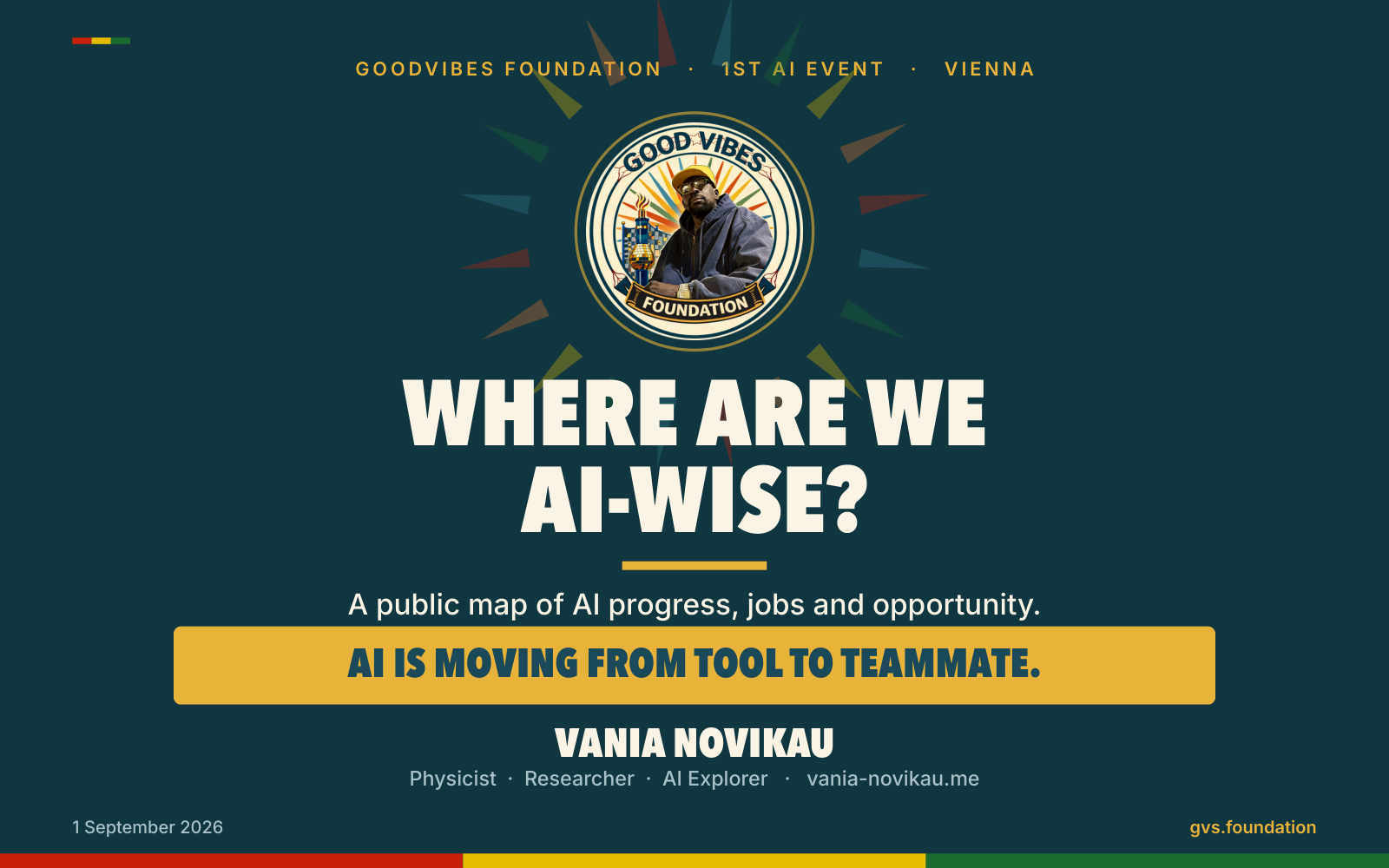
The talk: “Where are we, AI-wise?”
The opening session was Dr. Ivan S. Novikau’s Where are we, AI-wise? — a public map of AI progress, jobs and opportunity, in seventeen slides. Its argument in one sentence: human history has a handful of technologies that multiplied physical or informational power — agriculture, writing, printing, steam, electricity, computing, the internet — and AI is the first one that multiplies thinking work.
From there it stayed concrete. What actually changed is that the interface became conversation: you used to learn the computer’s language, now it learns yours. What AI can already do — read, write, code, design, teach, automate — sits directly beside what it still cannot, because the frontier is jagged: brilliant at one task and useless at the one next to it. So the skill that matters is verification, not prompting. AGI is a range rather than a date; prediction markets point at the early 2030s and surveyed researchers point considerably later. Measured productivity gains run about 1.2× for people who use AI for drafts and 2–3× for people who redesign the whole workflow. The labour-market signal so far is reduced hiring rather than layoffs, concentrated on the junior tasks.
The closing ask was deliberately small: pick one recurring task, get the first draft from AI, ask it to critique its own work, verify the facts yourself, and save the result as a checklist. First speed, then quality, then a reusable system. Do not wait for AGI — start with one workflow. Every number in the deck is sourced, and the sources are listed on the final slides.
How it went
The recap below runs eighty-three seconds. The evening was not solemn. The talk came in over the wire — dialled in from poolside — while the room in Vienna watched. The second slot, billed only as “Mr. π — mystery surprise session, topic revealed at the event”, turned out to be a German-language session on the singularity question: the feeling machine and the technoid human, pattern recognition all the way down, and a slide titled simply “Ende?”
Entrance was free, capacity was limited, and the venue was the arch at Spittelauer Lände 12 in Vienna. The recap ends the way the evening did — thank you for the first one, the next one is coming.
Full event details are on the GoodVibes Foundation event page.